
Examination results, together
Review measurements and earlier examinations in one place.
Ontol Scribe
Prepare drafts in your hospital’s style, ready for clinician review and approval.
Prepare a comprehensive opinion draft in just one minute. Let Ontol AI handle repetitive writing so clinicians can focus on review and judgment.
Recorded measurements and examination findings.
| Test | Result | Status |
|---|---|---|
| TSH | 3.04 U/mL | Normal |
| Blood Sugar (FBS) | 98 mg/dL | Normal |
| Vitamin D | 28.9 ng/mL | Low |
| LDL | 142 mg/dL | Caution |
| Liver Ultrasound | No abnormal findings | Normal |
| Blood Pressure | 118/76 mmHg | Normal |
| Free T4 | 1.40 ng/dl | Normal |
| Bilirubin | 0.8 mg/dL | Normal |
A draft for clinicians to review and edit.
AI-generated content must be reviewed and finalized by a clinician.
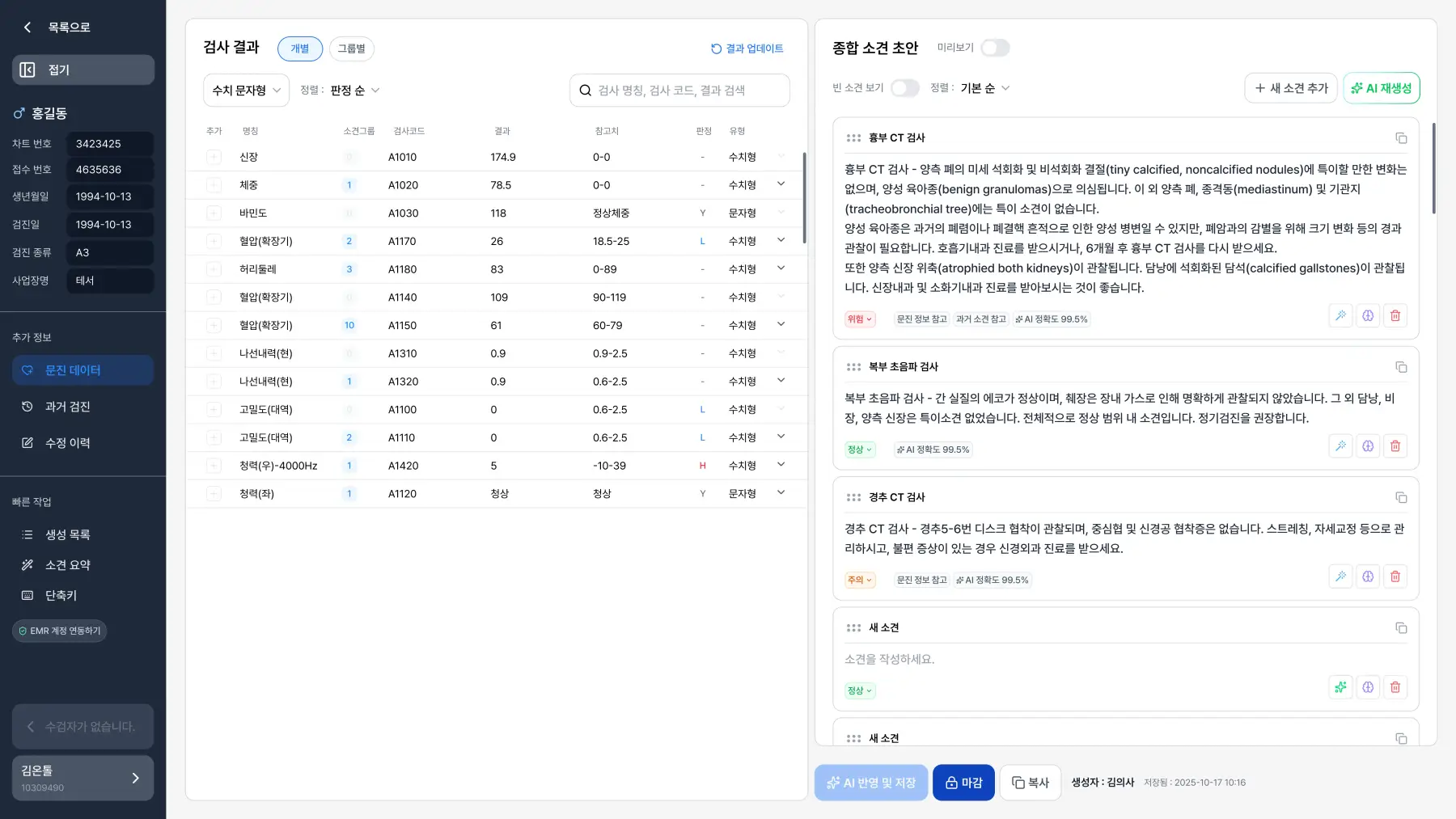
Review measurements and earlier examinations in one place.
The AI organizes findings using the hospital’s criteria and wording.
The clinician checks the original results and finalizes the opinion.
An AI opinion-writing assistant that reflects your hospital’s existing wording and assessment criteria. It connects to your screening program to prepare drafts from examination results and history, leaving review and approval to clinicians.
TAILORED TO YOUR HOSPITAL
Existing opinions, assessment criteria and recommendations shape each draft. Support a shared hospital style or individual clinicians’ styles.
Clinicians’ edits and saved instructions help refine subsequent drafts to match the hospital’s practice.
Clinicians review and finalize the draft before the approved opinion is saved back to the screening system.
Keep the screening program you use. Connect the capabilities your team needs.
Bring together screening history, questionnaires, consultation notes and connected records, according to the hospital’s integration scope.
Turn specialist findings from endoscopy, ultrasound or MRI into concise language for patients.
Read PDF, image and Excel reports, organize them by examinee, and incorporate the information into opinion drafts.
Translate opinions into six languages with hospital terminology, summarize key points and export summaries to Excel for follow-up work.
Flag possible spelling, decimal, numerical and logical inconsistencies in narrative results for a clinician to review.
Less repetitive work.
More room for clinical judgment.
Open and organize each result.
Find and compare earlier examinations.
Compose a draft for every patient.
Revise wording and templates manually.
The clinician makes the final decision.
Reflect hospital data, templates and writing rules.
Review a draft informed by results and history, then finalize it.
AI prepares the draft.
Your clinical team makes the decision.
Ontol Scribe delivers enterprise-grade security through an architecture built on international medical information protection standards.
All data transmissions are encrypted via TLS 1.3 protocol, and sensitive patient information is protected with AES-256 field-level encryption. Hospital-specific isolated databases and dedicated secure networks are established to block unauthorized external access at the source.
No personally identifiable information is passed to the AI engine. Identifiers such as names and contact details (PII) are automatically de-identified before AI calls, and all AI usage history is comprehensively logged by hospital, reception, and timestamp for transparent management.
Every data access request is logged with a unique tracking ID, and sensitive information is automatically masked during retention. Role-Based Access Control (RBAC) strictly limits data access scope by role, ensuring operational integrity.
From the first conversation to daily use, we shape the introduction around your hospital.
Contact usWe design a solution configuration suited to your hospital's size and operations.
After signing a standard contract, we proceed with integration settings for your hospital's EMR.
We complete the API connection with existing screening data and EMR systems.
During the 2-week pilot period, we verify quality with actual screening data.
2-week pilotAfter verification, we apply to full hospital operations and continuously refine.
No. A clinician reviews, edits and finalizes the AI draft. Only approved opinions are reflected in the screening system and patient report.
Existing opinions and writing instructions inform each draft. Individual clinician styles can also be configured, with edits reflected in subsequent drafts.
Integration examples include Saerom, Areumnuri, Heewon and nU. The scope, method and schedule are confirmed after reviewing your hospital’s IT environment.
Yes. Keep your existing opinion-writing workflow and introduce mobile delivery independently. Printed reports can still be provided to examinees who need them.
Report navigation and AI conversations support Korean, English, Japanese, Chinese, Vietnamese, Russian and Mongolian. Opinion-text translation requires use with Ontol Scribe.
With 300+ monthly screenings, adoption is cost-effective. We offer flexible pricing based on hospital scale and propose configurations tailored to your situation during the consultation.
From initial inquiry to a customized demo, the Tesser team is with you every step of the way.